What to measure
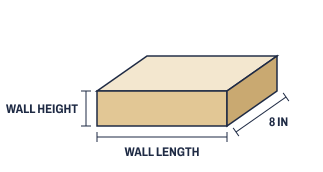
How to use the concrete block calculator
Enter the wall’s length and height and choose the block face size. Keep 5% for breakage and cut blocks. Calculate each wall separately; corners share blocks, so the total will be slightly high.
The formula
- Blocks per course = wall length (in) ÷ 16, rounded up
- Courses = wall height (in) ÷ 8, rounded up
- Blocks = blocks per course × courses × (1 + extra %)
- Mortar bags = blocks ÷ 13
Worked example: 20 × 4 ft garden wall
- 240 in ÷ 16 = 15 blocks per course
- 48 in ÷ 8 = 6 courses → 90 blocks
- Plus 5%: 95 blocks; 95 ÷ 13 → 8 bags of mortar mix
Retaining walls and load-bearing walls need footings, reinforcement and grouted cores designed to local code. Use the rebar calculator for the steel, and check with your building department.
Blocks for common wall sizes
16 × 8 in face, 5% extra, mortar at 13 blocks per bag.
| Wall (length × height) | Layout | Blocks | Mortar bags |
|---|---|---|---|
| 10 × 3 ft | 5 courses × 8 | 42 | 4 |
| 20 × 4 ft | 6 courses × 15 | 95 | 8 |
| 20 × 6 ft | 9 courses × 15 | 142 | 11 |
| 30 × 4 ft | 6 courses × 23 | 145 | 12 |
| 40 × 6 ft | 9 courses × 30 | 284 | 22 |
| 50 × 8 ft | 12 courses × 38 | 479 | 37 |
Common mistakes
- Using the block’s actual size. A block sold as 8 × 8 × 16 is slightly smaller so the mortar joint brings it to 16 × 8 in. Count with the nominal size.
- Measuring height from the ground. Courses below grade count too. Measure from the top of the footing.
- Counting corners twice. Where two walls meet, the corner blocks belong to both. Totals for separate walls run slightly high.
- Buying no spares. Blocks chip in delivery and cut ends get wasted. Keep the extra for breakage.
Frequently asked questions
How many concrete blocks per square foot?
1.125 standard blocks per square foot of wall. An 8 × 8 × 16 block takes up 16 × 8 inches of wall face including the 3/8 in mortar joint — 0.89 sq ft.
How many blocks per bag of mortar?
One 80 lb bag of mortar mix lays about 13 standard 8 × 8 × 16 blocks.
How many blocks for a 20 ft wall 4 ft high?
6 courses of 15 blocks = 90 blocks, or 95 with 5% extra — plus 8 bags of mortar mix.
Does the block width matter?
Not for the count — 6, 8, 10 and 12 in blocks all have the same 16 × 8 in face. Width matters for strength, cost and weight.
How many blocks are in a 100 square foot wall?
A 10 × 10 ft wall is 15 courses of 8 blocks, or 120 blocks. With 5% extra that's 126 blocks and 10 bags of mortar mix.
How many courses of block for a 6 ft wall?
9 courses of 8 in high blocks (72 in ÷ 8). A 20 ft long wall at that height takes 142 blocks with 5% extra.
How many half-high blocks do I need?
Twice as many courses as full-height block. A 20 × 4 ft wall in 16 × 4 in half-high block is 12 courses of 15, or 189 blocks with 5% extra.
Sources
Formulas and defaults last reviewed October 30, 2026. How we check our math.