What to measure
How to use the retaining wall calculator
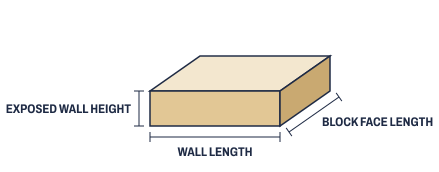
Enter the wall length and the height you want above ground. Enter your block’s face length and height (it’s on the product label). Keep “bury the first course” on. Base and drainage dimensions are typical defaults — replace them with the ones in your block’s installation guide.
The formula
- Blocks per course = wall length ÷ block face length, rounded up
- Courses = exposed height ÷ block height, rounded up, + 1 buried course
- Caps = wall length ÷ cap length
- Base gravel = length × base width × base depth; drainage gravel = length × drainage width × full wall height, both at 1.35 tons per cubic yard
Worked example: 20 ft wall, 3 ft high, 12 × 4 in block
- 240 in ÷ 12 = 20 blocks per course
- 36 in ÷ 4 = 9 courses + 1 buried = 10 courses → 200 blocks, 20 caps
- Base: 20 × 2 × 0.5 ft = 20 cu ft → about 1 ton of crushed stone
- Drainage: 20 × 1 × 3.33 ft = 66.7 cu ft → about 3.33 tons
Walls that hold back a slope, a driveway or a structure — or any wall over about 4 ft — need an engineer and often a permit.
Blocks and gravel by wall size
12 × 4 in blocks with one buried course, a 24 × 6 in gravel base and 12 in of drainage gravel. With 12 in caps, the cap count equals the wall length in feet.
| Wall (length × height) | Wall blocks | Base gravel | Drainage gravel |
|---|---|---|---|
| 10 × 1 ft | 40 | 0.5 tons | 0.67 tons |
| 10 × 2 ft | 70 | 0.5 tons | 1.17 tons |
| 20 × 2 ft | 140 | 1 ton | 2.33 tons |
| 20 × 3 ft | 200 | 1 ton | 3.33 tons |
| 30 × 2 ft | 210 | 1.5 tons | 3.5 tons |
| 30 × 3 ft | 300 | 1.5 tons | 5 tons |
| 50 × 3 ft | 500 | 2.5 tons | 8.33 tons |
Common mistakes
- Using the block’s depth as its face length. Blocks per course come from the length of the face you see, not how deep the block goes into the wall.
- Forgetting the buried course. Measure the exposed height above ground, then let the calculator add the course below grade.
- Backfilling with dirt behind the wall. Water trapped in soil pushes on the wall. Keep the drainage gravel and drain pipe from the results.
- Skipping the base. A wall on uncompacted soil leans as it settles. Build and compact the gravel base first.
Frequently asked questions
How many retaining wall blocks do I need?
Divide the wall length by the block's face length for blocks per course, and the height by the block height for courses — plus one buried course. A 20 ft wall, 3 ft high, with 12 × 4 in blocks needs 200 blocks.
Should the first course be buried?
Yes. Most manufacturers call for the first course to be partly or fully below grade so the wall can't slide out at the base.
How much gravel goes under a retaining wall?
Block makers typically specify a trench about 24 in wide with 6 in of compacted crushed stone for small walls. Use your manufacturer's figures — the calculator lets you change both.
How tall can I build a block retaining wall myself?
Many codes, including the IRC (R404.4), require an engineered design for walls retaining more than 4 ft of soil. Gravity block walls are usually limited to 2–4 ft depending on the block.
How many blocks for a 20 ft wall with larger blocks?
For a 3 ft exposed height with one buried course, 16 × 6 in blocks take 105 (7 courses of 15), and 18 × 8 in blocks take 84 (6 courses of 14). Use the face size on your block's label.
How many blocks does the buried course add?
One full course. For a 20 ft wall, 3 ft high, with 12 × 4 in blocks, that's 20 blocks, so 200 instead of 180.
How much drainage gravel goes behind a retaining wall?
For a 12 in wide drainage zone the full height of the wall, a 30 ft wall 3 ft high needs 3.7 cubic yards, about 5 tons of crushed stone.
Sources
Formulas and defaults last reviewed October 30, 2026. How we check our math.