What to measure
How to use the stair calculator
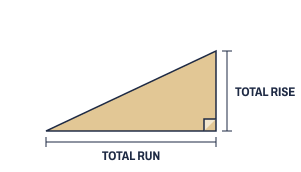
Measure the total rise: from the finished lower floor to the finished upper floor. Keep the maximum riser at 7¾ in unless your code is different, and enter the tread depth you want (10 in minimum under the IRC). The calculator finds the fewest risers that stay under the maximum, then divides the rise evenly.
To cut the stringers — framing square marks, the bottom riser cut and how many boards — use the stair stringer calculator.
The formula
- Risers = total rise ÷ maximum riser, rounded up
- Riser height = total rise ÷ risers
- Treads = risers − 1; total run = treads × tread depth
- Stringer ≈ √(rise² + run²)
Worked example: 105 in floor to floor
- 105 ÷ 7.75 = 13.5 → 14 risers, each 105 ÷ 14 = 7½ in
- 13 treads × 10 in = 10 ft 10 in of run
- Stringer ≈ √(105² + 130²) = 13 ft 11⅛ in; angle 38.9°
- Comfort: 2 × 7.5 + 10 = 25 in ✓
Results are fractions to the nearest 1/16 in. The top tread is the upper floor itself, which is why there is one fewer tread than risers.
Steps by total rise
7¾ in maximum riser, 10 in treads.
| Total rise | Risers / treads | Riser height | Total run |
|---|---|---|---|
| 24 in | 4 / 3 | 6 in | 2 ft 6 in |
| 30 in | 4 / 3 | 7 1/2 in | 2 ft 6 in |
| 36 in | 5 / 4 | 7 3/16 in | 3 ft 4 in |
| 48 in | 7 / 6 | 6 7/8 in | 5 ft 0 in |
| 72 in | 10 / 9 | 7 3/16 in | 7 ft 6 in |
| 96 in | 13 / 12 | 7 3/8 in | 10 ft 0 in |
| 108 in | 14 / 13 | 7 11/16 in | 10 ft 10 in |
| 120 in | 16 / 15 | 7 1/2 in | 12 ft 6 in |
Common mistakes
- Measuring from the subfloor. Measure finished floor to finished floor. Flooring added later changes the top and bottom steps.
- Uneven first or last step. The IRC allows the tallest riser in a flight to exceed the shortest by no more than 3/8 in. Divide the rise evenly instead of trimming one step.
- Counting one tread too many. The upper floor is the top step, so there is one fewer tread than risers.
- Buying a stringer at the exact length. The figure is the straight line from bottom to top. Leave room for the top and bottom cuts.
Frequently asked questions
What is the maximum stair riser height?
7¾ inches under the International Residential Code (R311.7.5.1), with a minimum tread depth of 10 inches (R311.7.5.2). Some local codes differ — check yours.
How many steps do I need for 8 feet?
For a 96 in rise, 13 risers of about 7⅜ in each, with 12 treads. Measure your actual floor-to-floor height — it's usually more than the ceiling height.
What is a comfortable stair?
A common rule is 2 × riser + tread = 24–25 inches. A 7½ in riser with a 10 in tread gives 25 in.
Is the stringer length exact?
It's the straight-line length of the stair from bottom to top. The board you cut runs one step further, so it's longer by about one step's diagonal; the stair stringer calculator gives that board length and how many to buy.
How many steps do I need for a 3 ft deck?
For a 36 in rise, 5 risers of 7 3/16 in and 4 treads. With 10 in treads the stairs run 3 ft 4 in out from the deck.
How long a stringer do I need for a 9 ft rise?
A 108 in rise takes 14 risers of 7 11/16 in. With 10 in treads the stair is about 14 ft 1 in long on the slope, and each stringer board about 14 ft 8 13/16 in, so 16 ft boards.
Can I make the steps lower than 7¾ inches?
Yes, set a lower maximum riser. At 7 in, a 96 in rise takes 14 risers of 6 7/8 in instead of 13, and the run grows from 10 ft to 10 ft 10 in.
Sources
Formulas and defaults last reviewed October 30, 2026. How we check our math.